
The Part Nobody Talks About
When we started homeschooling, I honestly thought there was one “right” way. Over time, I discovered the hidden side of homeschooling creatively — using games, movement, and imagination to help my kids learn without overspending.
I wanted my little boy to stay home with me — it just felt right. But I didn’t fully understand the weight of the decision we were making. And I certainly didn’t know how much it would cost us — in both money and stress.
I thought homeschooling required buying things.
Curriculum. Supplies. Printables. Programs.
If something didn’t work, I assumed the answer was to buy something better. That belief? It cost us years — and a lot of money.
Seven Styles Later… What Actually Worked
Over the years, we’ve tried seven different homeschool styles. Not because we were indecisive — but because our kids grew, our seasons changed, and what worked once simply stopped working.
Here’s the truth I learned:
Homeschool styles are tools. They’re not identities. You’re allowed to set a tool down when it no longer works.
Some of the styles we tried:
Traditional Homeschooling – Felt safe and familiar at first, but soon left no room for curiosity.
Unit Studies – Magical in theory, but I overbought, overplanned, and overprinted.
Charlotte Mason – Beautiful in concept, but reality interrupted constantly. Auditory learning didn’t work for my oldest.
Classical Education – Structure helped briefly, but memorization cycles frustrated my kids.
Eclectic – Flexibility and customization finally made sense. One child thrived with Miacademy, others with a mix of hands-on activities and movement-based learning.
Game Schooling – This wasn’t intentional at first, but it worked the best. Learning stuck when we played, laughed, and moved.
I actually tell that whole story in my book Schooling at Home with Nerds — how we accidentally found our way into game schooling and why it ended up fitting our family better than anything else we tried.

As an Amazon Associate, I earn from qualifying purchases.
This post may contain affiliate links. If you click one and make a purchase, I may earn a small commission at no extra cost to you.
What all these styles taught me:
- No single style fits every child.
- What works in one season may fail in another.
- Burnout is feedback — not failure.
- Switching styles isn’t quitting; it’s adapting.
You’re allowed to evolve. You’re allowed to trust yourself.
The Curriculum Spending Spiral
Early on, Pinterest made unit studies look magical. I bought everything: sensory bins, themed books, printables, supplies. By the end of our first year, things were harder, not easier.
I didn’t know how to use free resources. I didn’t trust myself to create lessons. I thought curriculum had to be purchased.
Then life forced creativity.
After a hurricane damaged our house, all our curriculum was packed away. So we played board games. Watched game shows. Talked, problem-solved, learned.
No worksheets. No programs. And learning still happened.
That season taught me something powerful:
What looks good on paper doesn’t always work in real life.
This was my first experience with what I call the curriculum trap.
👉 How to Avoid the Curriculum Trap
Learning Through Movement and Games While Homeschooling Creatively
When money got tight — with my husband going back to school and AI impacting the job market — I panicked. I couldn’t reorder curriculum.
Then I remembered: we had done this before. And it worked.
I stopped asking:
“What do I need to buy?”
And started asking:
“What do we already have?”
- Board games
- Books
- Movies and documentaries
- Libraries and websites
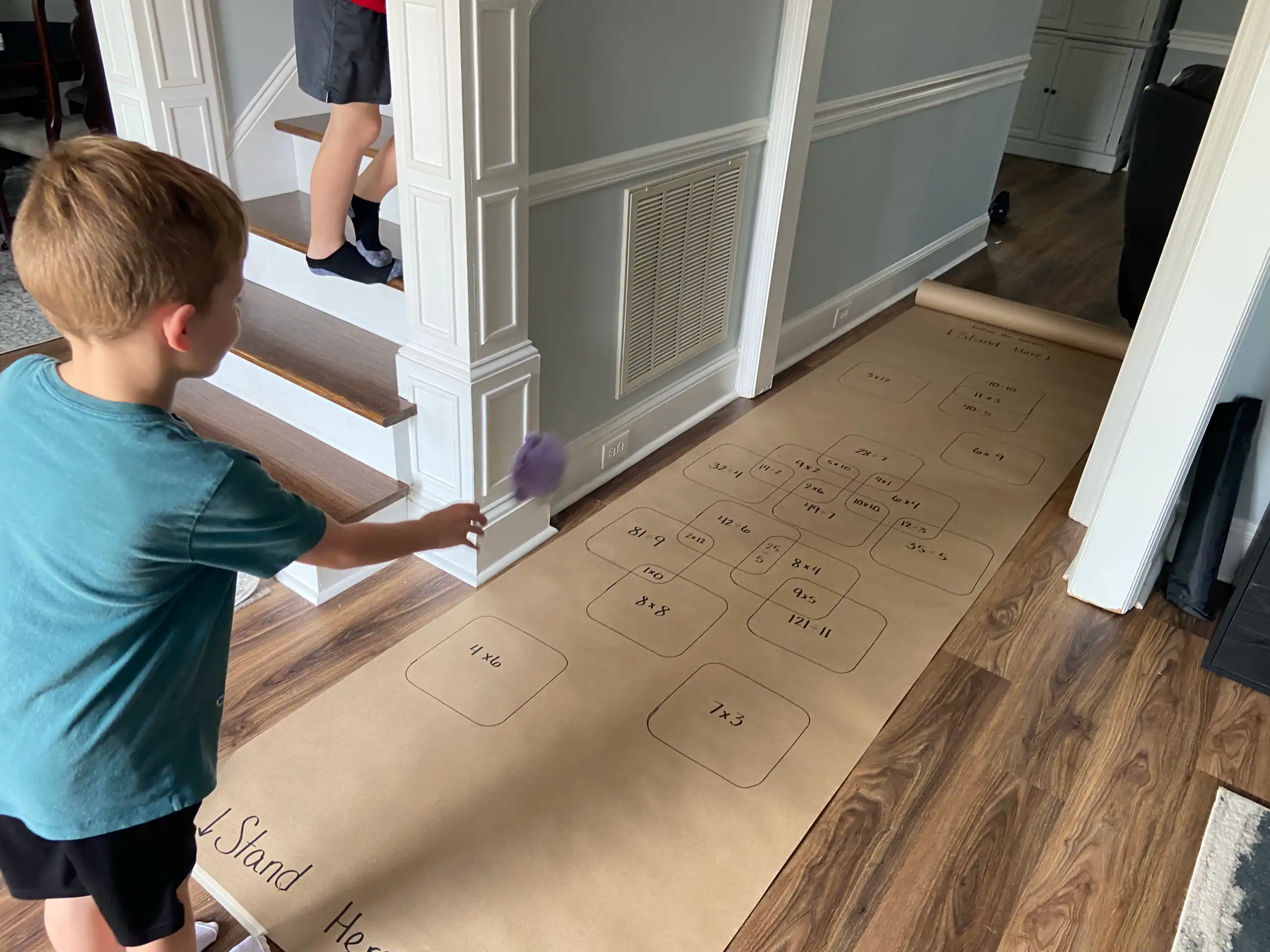
- A roll of paper from Lowe’s
Using what we already owned, I created movement-based lessons for my younger two:
- Math became jumping
- Spelling became racing
- Learning moved off the table and onto the floor
That roll of paper did more than another boxed curriculum ever could.
What We’re Doing Now (On Purpose)
- Miacademy for my oldest
- Education.com + games for my younger two
- Who Was + Story of the World for history
- Book reports instead of workbooks
Simple. Affordable. Sustainable.
We use online tools like Miacademy and Education.com to supplement learning, and even screen time can teach if it’s done intentionally.
👉 Screen Time That Teaches
We also continue to create games and activities to expand learning without spending more money — including a D&D creative writing curriculum. Kids learn problem-solving, critical thinking, and imagination while having fun.
If You’re Feeling Guilty About Money
Let me say this plainly:
- You’re not irresponsible.
- You weren’t wasting money.
- You were trying to do right by your kids.
And that matters.
Chasing the “perfect curriculum” is a trap many homeschoolers fall into. Looking back, I realized that no curriculum is perfect — it’s about finding what works for your child.
👉 The Perfect Curriculum: A Different Perspective
Less Stuff, More Trust
Homeschooling didn’t become cheaper because I found better deals.
It became cheaper because I trusted myself more.
It became richer because we played, created, and learned together.
And that made all the difference.
Coming Soon: A Free D&D Creative Writing Curriculum
We’re still perfecting our D&D-inspired creative writing curriculum, making sure it’s as fun, engaging, and easy-to-use as possible. Once it’s ready, I’ll be sharing it as a freebie for all homeschool families.
Kids will get to explore storytelling, problem-solving, critical thinking, and imagination — all while having a blast.
If you want to be the first to know when it’s available, make sure to subscribe to my newsletter or follow along here on the blog!
Leave a Reply